
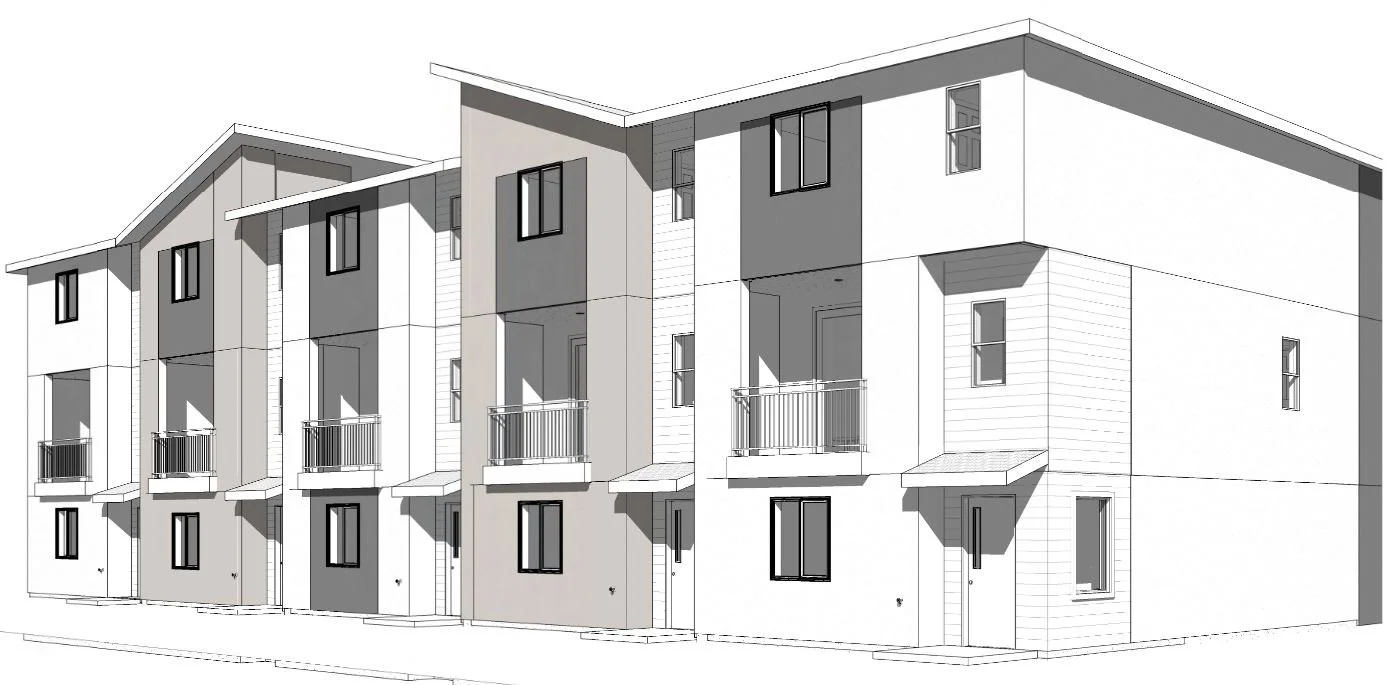
When people think about what architects do, they usually picture design.
Sketches. Renderings. Beautiful buildings.
Maybe a black turtleneck somewhere in the mix.
That part exists. But it is a small percentage of the job.
Most of what architects do never ends up on Instagram.
As a licensed architect practicing in Boise, most of the work happens long before anything looks good in a photo.
It Is Not Just About Design
Yes, we design buildings.
But we are also legally responsible for the life, safety, and welfare of the public. That is not a poetic phrase. It is written into the license.
Every decision has consequences.
A beam is not just a line on paper.
A stair is not just a form.
A wall is not just a backdrop for a nice finish.
Buildings have to stand up.
They have to drain correctly.
They have to meet code.
They have to get people out safely in an emergency.
A building that looks good but does not function is just an expensive sculpture.
That is not the goal.
We Produce Plans That Contractors Can Actually Build From
Behind every finished project in Boise or anywhere else are hundreds of hours of drawings.
Not the pretty ones.
The detailed ones.
Construction documents are instructions. They have to communicate clearly enough that a contractor can price the job, build it correctly, and pass inspections.
They must satisfy zoning code, building code, fire code, energy code, and accessibility requirements. Often all at once.
If something is missed, it does not get caught in a mood board. It gets caught in the field.
Which is a much more expensive place to find it.
We Navigate Permitting So You Do Not Have To
Permitting is rarely straightforward.
Planning review.
Zoning compliance.
Design review boards.
Building department comments.
In Boise and throughout Idaho, those steps often happen sequentially and each one can require revisions.
Part of what architects do is manage that process. We prepare submittals, respond to review comments, attend meetings, and keep the project moving.
It is not glamorous work.
No one frames their permit approval letter.
But without it, nothing gets built.
We Coordinate Everyone and Everything
Buildings are collaborative whether you want them to be or not.
Structural engineers.
Mechanical engineers.
Electrical engineers.
Civil engineers.
Contractors.
All of their work overlaps.
Someone has to make sure the structural beam does not cut through the ductwork. That the lighting layout does not conflict with framing. That accessibility requirements are met without turning the space into a maze.
When coordination is done well, no one notices.
When it is done poorly, everyone does.
We Design for Accessibility and Longevity
Accessibility is not a feature you add at the end. It is a requirement.
Door widths. Clearances. Slopes. Restrooms. Egress.
These are not suggestions.
At the same time, good architecture in Idaho has to account for climate, durability, and long term performance. Sustainable design is not just about adding technology. It is about making decisions that reduce waste and increase efficiency over time.
The goal is not just to build something that works on day one. It is to build something that still works years later.
We Work With Existing Buildings Too
Not every project starts with an empty lot.
Adaptive reuse projects can be more complicated than new construction.
Older buildings come with surprises. Structural limitations. Outdated systems. Code issues that did not exist when the building was first constructed.
Part of the job is figuring out how to work within those constraints without pretending they are not there.
That usually requires creativity. And patience.
We Stay Involved During Construction
A common assumption is that once the permit is issued, the architect disappears.
That is not how responsible practice works.
During construction, questions come up. Conditions change. Substitutions are proposed.
Architects review submittals, answer contractor questions, visit the site, and make sure what is being built matches what was approved.
Sometimes that means agreeing to a smarter solution.
Sometimes that means saying no.
Both are part of the job.
So What Do Architects Actually Do
More than draw.
We guide projects from early feasibility through permitting and into construction.
We balance design, code compliance, coordination, budget realities, and constructability.
If you are planning a residential or commercial project in Boise or the surrounding Treasure Valley, understand this.
You are not just hiring someone to make something look good.
You are hiring someone to make sure it works. Legally. Structurally. Practically.
It is less glamorous than people imagine.
It is also far more important.